Why AidBioMechanismNetworksDataModelsSoftwareAidBioPortfolio← AidBio.com
Chapter 02 · Complexity becomes a network

One regulator became many interacting parts.

Studying which proteins physically touch and influence each other changed the unit of reasoning. Instead of asking only "what does this one gene do?", the question became: what pattern emerges once you map out how hundreds of these relationships connect?

UC Davis · 2017–2019

Experimental interaction maps are graphs in disguise.

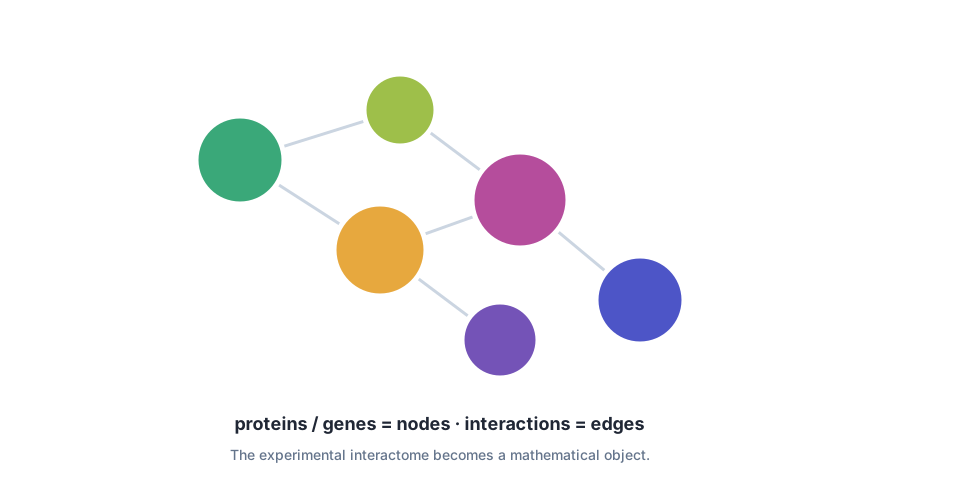
At UC Davis, the work centered on a lab technique called yeast two-hybrid (Y2H) — essentially a way of testing, pair by pair, whether two proteins physically stick together inside a cell. Do that at scale across thousands of pairs, and what you get is a map: proteins are the dots, and a "yes, they interact" result is a line connecting two dots.

That map is really the same object a computer scientist calls a graph — dots and lines, or in that vocabulary, nodes and edges. Recognizing that a lab experiment and a graph are the same thing is what made the later move into graph-based machine learning possible.

Network diagram showing proteins as graph nodes and interactions as edges
MOLECULAR PLANT-MICROBE INTERACTIONS · 2018

A reusable Arabidopsis Y2H resource

Rather than running one experiment to test one pair of proteins, this project built the reusable lab toolkit that lets any researcher run that kind of test systematically, at scale.

Matiolli CC, Melotto M. A Comprehensive Arabidopsis Yeast Two-Hybrid Library for Protein-Protein Interaction Studies: A Resource to the Plant Research Community. MPMI 31, 899–902 (2018). DOI: 10.1094/MPMI-02-18-0047-A.

BMC PLANT BIOLOGY · 2020 · CC BY 4.0

Networks meet food safety

This work studied how a plant defends itself against two foodborne pathogens, Salmonella and E. coli O157:H7 — the same bacteria that cause produce-linked food-safety outbreaks in humans. It identified specific plant defense genes (EXO70H4, NPR1, ICS1) that close the plant's leaf pores and reinforce cell walls to keep the bacteria out, some shared across both pathogens and some specific to one.

Oblessuc PR, Matiolli CC, Melotto M. Novel molecular components involved in callose-mediated Arabidopsis defense... BMC Plant Biology 20, 16 (2020). DOI: 10.1186/s12870-019-2232-x.

Open article →
ITQB NOVA · 2019–2024

Networks move into crop biology.

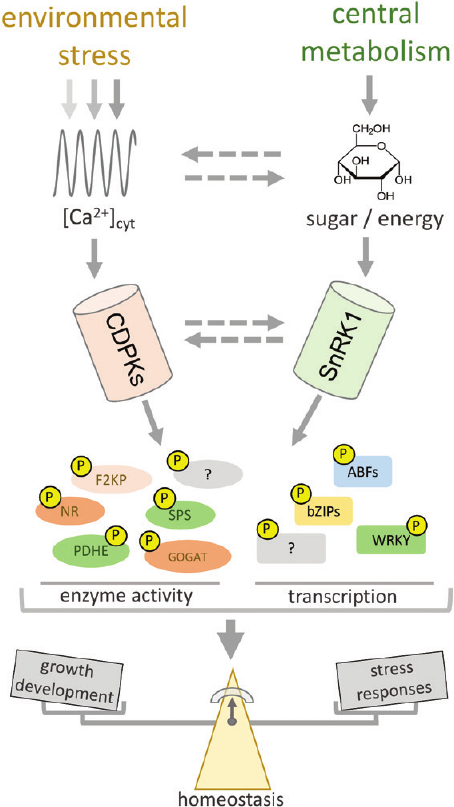
Representative model from Alves et al. 2021 integrating calcium-dependent protein kinases and SnRK1 to balance growth and stress responses
JOURNAL OF EXPERIMENTAL BOTANY · 2021 · CC BY

Integrating carbon/nitrogen and stress signalling

A review proposing how two families of "sensor" enzymes inside plant cells — calcium-dependent protein kinases (CDPKs) and SnRK1 — work together to balance normal growth metabolism against the plant's response to environmental stress, so it can keep functioning under pressure instead of shutting down.

Alves HLS†, Matiolli CC†, Soares RC, Almadanim MC, Oliveira MM, Abreu IA. Carbon/nitrogen metabolism and stress response networks – calcium-dependent protein kinases as the missing link? Journal of Experimental Botany 72, 4190–4201 (2021). DOI: 10.1093/jxb/erab136.

Open article →
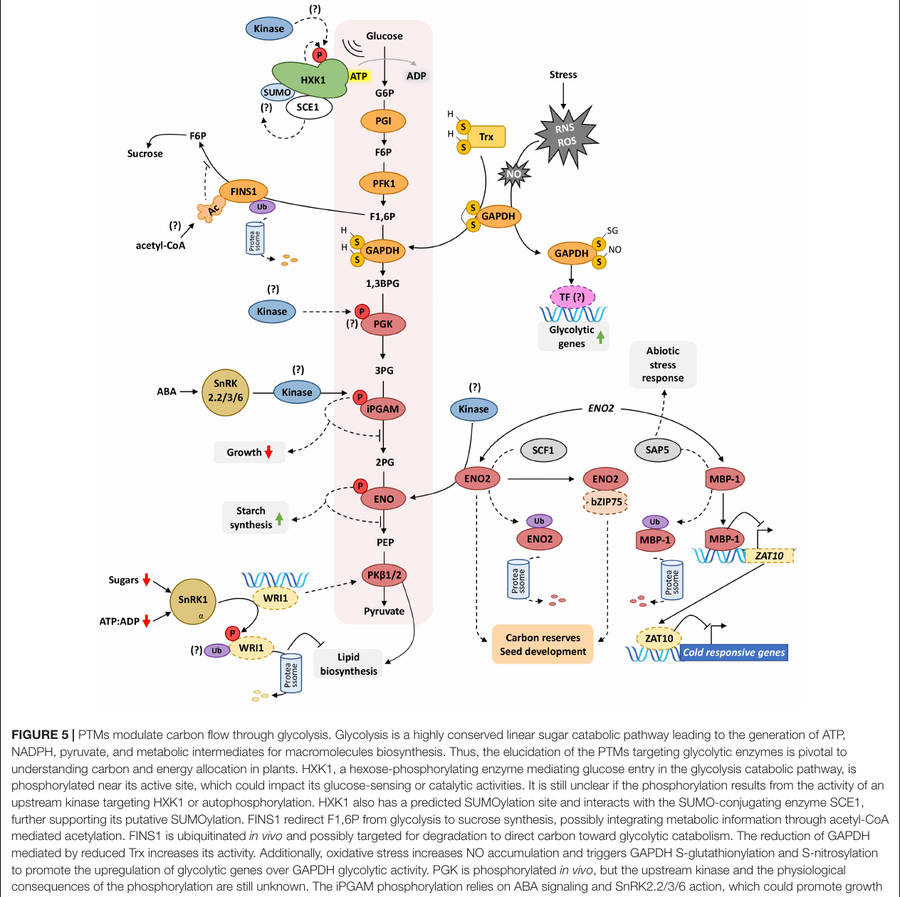
Pathway diagram from Matiolli et al. 2022 showing post-translational modifications modulating carbon flow through glycolysis
FRONTIERS IN PLANT SCIENCE · 2022 · CC BY

Post-translational regulation

Genes being "turned on" is only part of the story — proteins also get chemically tagged after they're built (phosphorylation, ubiquitination, SUMOylation, and others), and those tags can switch a protein on, off, or redirect what it does. This review makes the case that regulation happens on that layer too, not just at the gene level.

Matiolli CC†, Soares RC†, et al. Frontiers in Plant Science 12, 781508. DOI: 10.3389/fpls.2021.781508.

Open article →
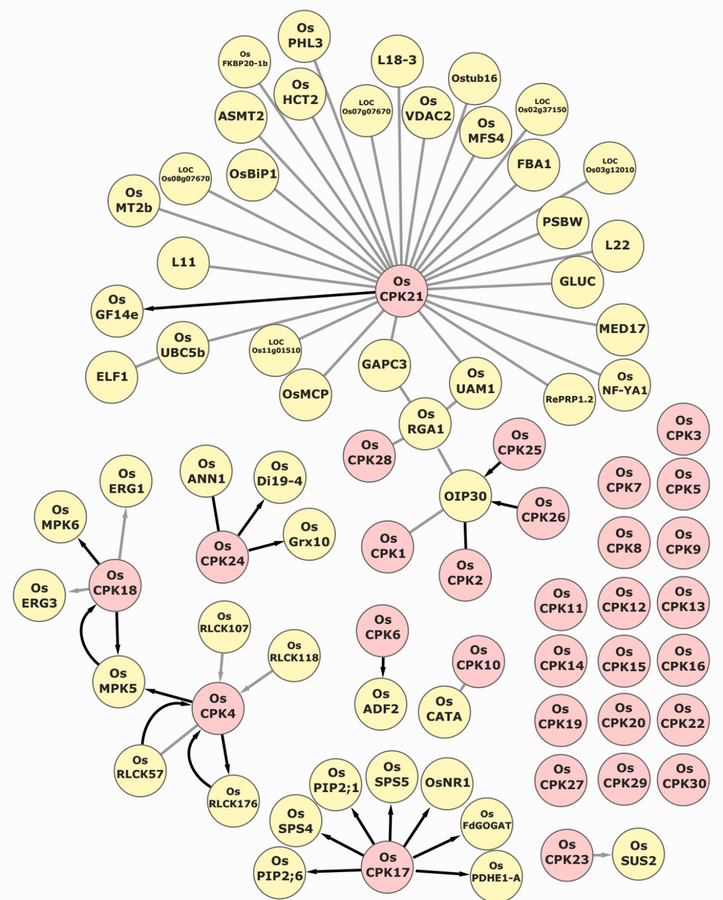
Rice CDPK protein-protein interaction network from Marques et al. 2022
MICROPUBLICATION BIOLOGY · 2022 · CC BY

CDPK-OsPPIN

A hand-curated map of how the same "sensor" enzyme family interacts inside rice plants, used to generate testable hypotheses about how rice balances its nutrient use against stress.

Marques J, Matiolli CC, Abreu IA. microPublication Biology (2022). DOI: 10.17912/micropub.biology.000513.

Open article →
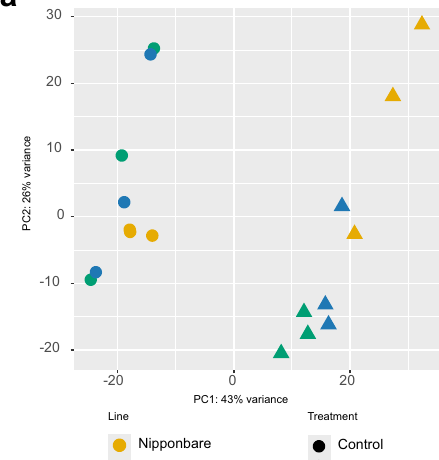
PCA plot from Fernandes et al. 2024 separating rice SLR1 and SUMO1-SLR1 lines by genotype and salt treatment
PLANTA · 2024 · CC BY

Rice stress & yield

This study showed that a small chemical tag (SUMO) attached to a key rice growth-control protein (DELLA/SLR1) changes how the plant responds to salt stress — and that the tagged version actually produced better yield under salty conditions. It's a direct line from a molecular detail to a trait a farmer would care about.

Fernandes T, Gonçalves NM, Matiolli CC, Rodrigues MAA, Barros PM, Oliveira MM, Abreu IA. SUMOylation of Rice DELLA SLR1 Modulates Transcriptional Responses and Improves Yield Under Salt Stress. Planta 260 (2024). DOI: 10.1007/s00425-024-04565-1.

Open article →