Why AidBioMechanismNetworksDataModelsSoftwareAidBioPortfolio← AidBio.com
Chapter 01 · Learn the mechanism

Before prediction, understand regulation.

The founder story begins with a small lab plant, Arabidopsis, and one regulatory protein called bZIP63 — a molecular "switch" that turns genes on or off. The real lesson wasn't about that one protein; it was about how to think about signals that interact rather than act alone.

Doctoral research · UNICAMP

A gene is rarely an isolated switch.

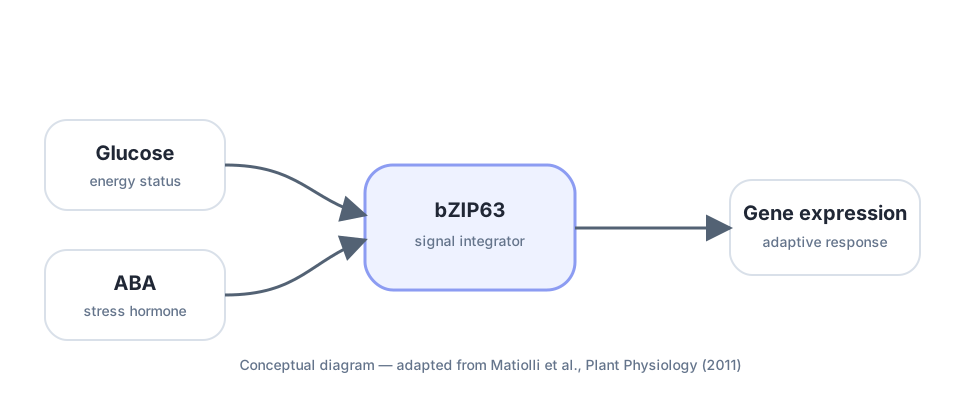
A 2011 study in Plant Physiology showed that AtbZIP63 reads two signals at once — how much sugar (glucose) is available, and how much of the stress hormone ABA is present — and combines them into a single decision about which genes to turn on. In plain terms: the plant's energy status and its stress alarm aren't separate conversations. They converge on the same switch.

That's the template this whole story follows, later translated into code: find the inputs, find the point where they combine, find what comes out the other end, and find the conditions where that relationship changes.

Tutorial takeaway. Ask six questions: What are the variables? Which interact? What is directly measured? What is inferred? What is plausibly causal? What could confound the result?
Glucose and ABA converge on bZIP63, leading to changes in gene expression
Primary evidence

From metabolic state to the plant clock

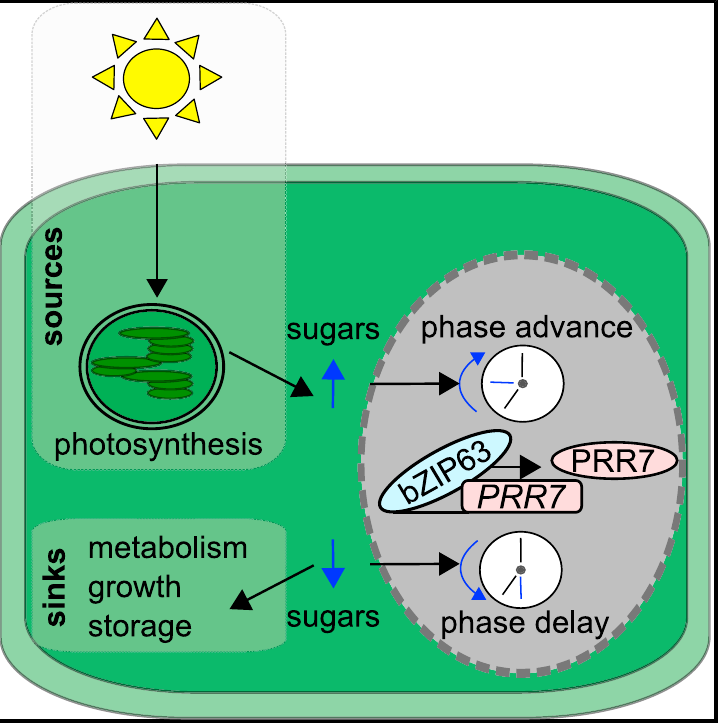
Graphical abstract from Frank et al. 2018 showing sugar-dependent circadian entrainment through bZIP63 and PRR7
CURRENT BIOLOGY · 2018 · CC BY 4.0

Circadian entrainment by sugars

This study showed that bZIP63 also controls a clock gene called PRR7 — so sugar levels in the plant can nudge its internal circadian clock earlier or later, through a short chain of energy-sensing signals (a sugar-derived molecule called Tre6P, an energy-sensing enzyme called SnRK1/KIN10, and bZIP63 itself).

Frank A, Matiolli CC†, et al. Circadian Entrainment in Arabidopsis by the Sugar-Responsive Transcription Factor bZIP63. Current Biology 28, 2597–2606.e6 (2018). DOI: 10.1016/j.cub.2018.05.092.

Open article →
Why this matters to the AidBio story

A single molecular switch turned out to be one link in a longer chain, one that connects sunlight to plant growth:

1 light drives photosynthesis
2 photosynthesis changes sugar availability
3 sugar/energy signalling regulates bZIP63
4 bZIP63 regulates PRR7
5 the circadian phase changes
6 timing affects metabolism and growth

The problem now spans molecules, timing and a visible outcome all at once — exactly the kind of many-layered picture that eventually needs a computer, not a whiteboard, to keep straight.

The same mechanism, but now it shows up in how big the plant gets.

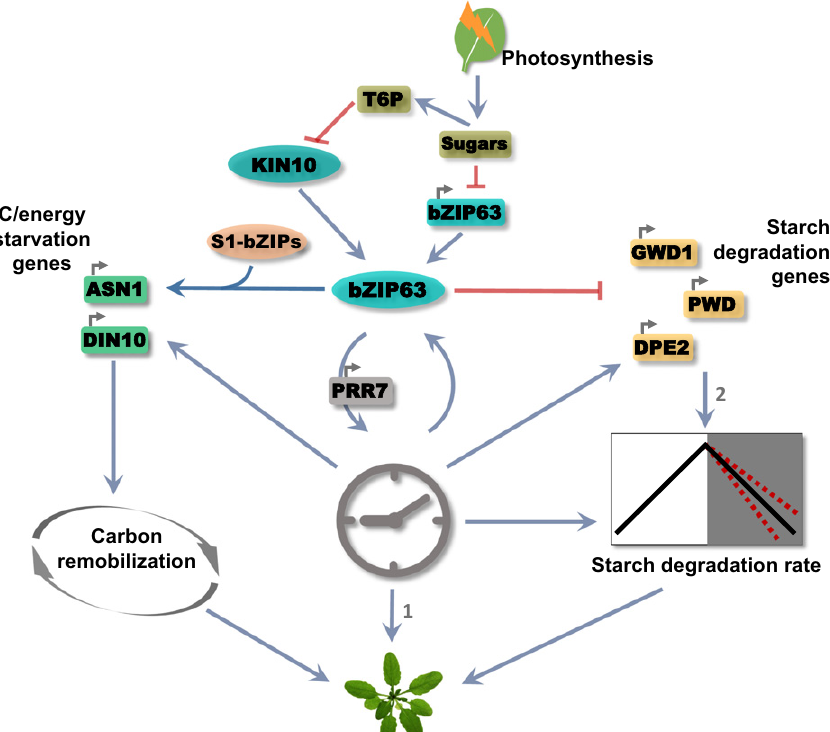
A 2021 study in New Phytologist found that plants missing working bZIP63 mismanage their overnight starch reserves and grow poorly when days are short. Their leaf area and dry weight both dropped substantially — turning an invisible timing problem into a plant that is visibly smaller than it should be.

Model figure from Viana et al. 2021 showing bZIP63 linking the circadian clock, sugar signalling and starch degradation rate to plant growth
NEW PHYTOLOGIST · 2021 · CC BY

bZIP63 modulates plant growth

Energy status ↔ internal clock ↔ overnight starch use ↔ how much the plant grows.

Viana AJC†, Matiolli CC†, et al. The sugar-responsive circadian clock regulator bZIP63 modulates plant growth. New Phytologist 231, 1875–1889 (2021). DOI: 10.1111/nph.17518.

Open article →